Some would say I should find a better Sunday-afternoon habit than AI and LinkedIn.
Instead, I made a family card game.
My son loves Dungeons & Dragons. He was introduced to it at school by a teacher, which I think is fantastic. I enjoy a good dungeon-master meme as much as the next person.
But left to my own devices, I am more likely to scroll on my phone than pull out a game box.
Unless there is already a group.
Then I like something that gives people an easy way in. Something that breaks the ice without demanding anyone perform, compete, or turn dinner into an enforced emotional debrief.
That was the starting point.
Could a simple deck of prompts create a better after-dinner interaction?
- Fun enough for teenagers.
- Safe enough for mixed generations.
- Not so deep that everyone ends up discussing their childhood.
- Not so chaotic that it becomes competitive family warfare .
The result was Chosen Company Cards: a rough prototype of 100 conversation prompts, organised into categories and laid out as printable A4 sheets
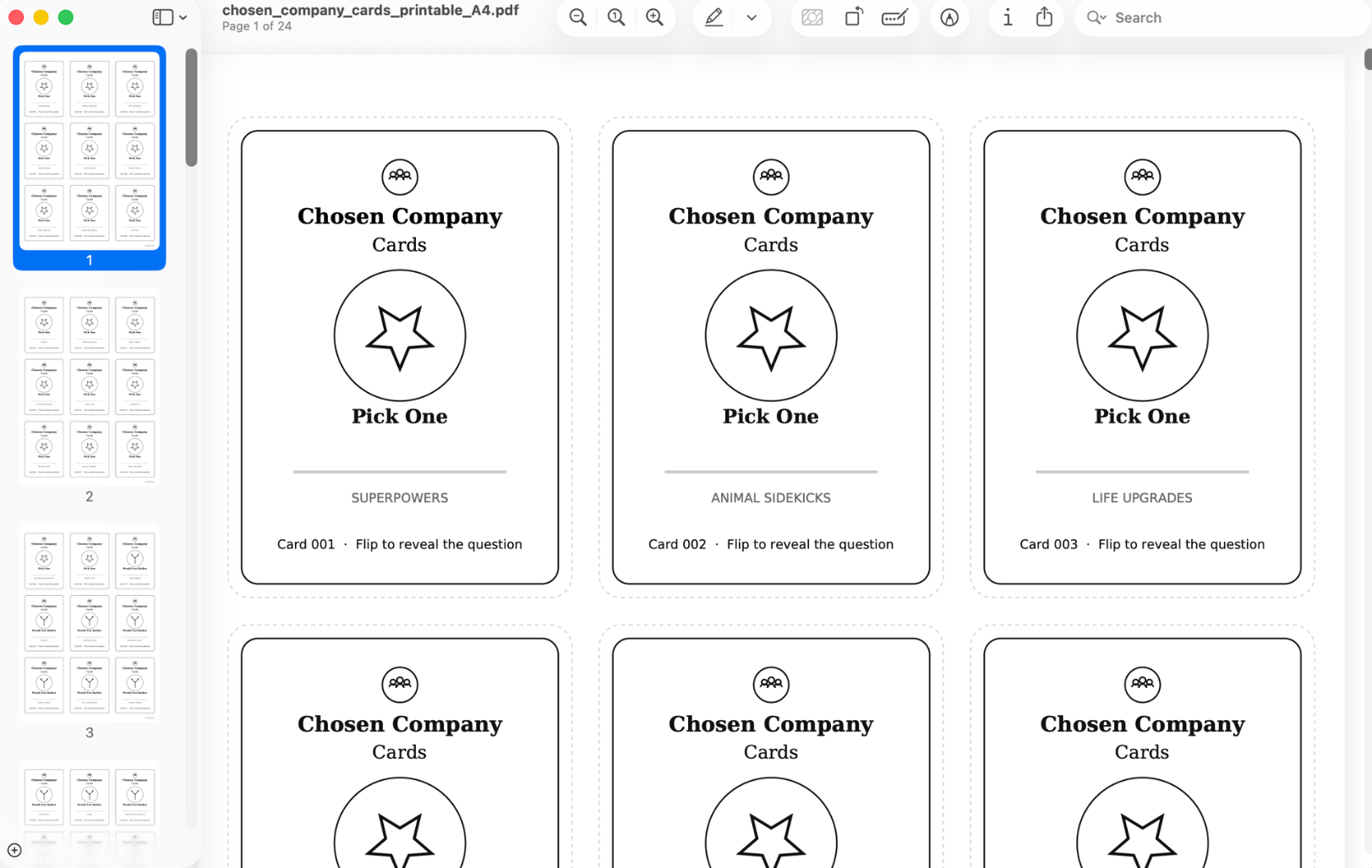
Working with AI made it practical to move quickly from a loose idea to something we could actually test. We developed the prompts, categories, visual direction, card fronts and backs, box artwork and mock-ups in an afternoon.
But the speed was not the most interesting part.
The useful part was making the idea concrete enough to examine.
A card is a small container for a decision. It gives a group a shared starting point, a little structure, and permission to engage without needing someone to carry the whole conversation.
That principle has wider uses.
Not every workplace problem needs to become a card game.
Please no.
There are too many needless meetings as it is, before introducing mandatory corporate play-dates.
But a well-designed prompt can sometimes help people practise judgement, explore trade-offs, surface assumptions, or discuss a change that is otherwise too vague or awkward to begin.
The format is not the point. The interaction is.
For example, a prompt-based tool might help a team:
- work through a decision with incomplete information
- identify what an experienced person knows that is not written down
- test whether an onboarding process prepares someone for real situations
- explore concerns before introducing a new system
- reflect on a project while the useful learning is still fresh
That does not make cards the answer. In many cases, a better process, a clearer checklist, a useful discussion guide, or a properly maintained knowledge base will be more appropriate.
The question is always: what would help people see the work more clearly, retain what they learn, and make better decisions next time?
Chosen Company Cards is still a prototype. It needs real-world testing, trimming, editing and probably the removal of a few cards once actual humans get hold of it.
It has also left behind something more useful than a family game: a repeatable way to turn a loose idea into a small, testable interaction tool.
I have put the draft files in a Git repository. You are welcome to adapt them, test them, pull them apart, or use them as a starting point.
If you make your own version, I would genuinely love to see where it ends up.